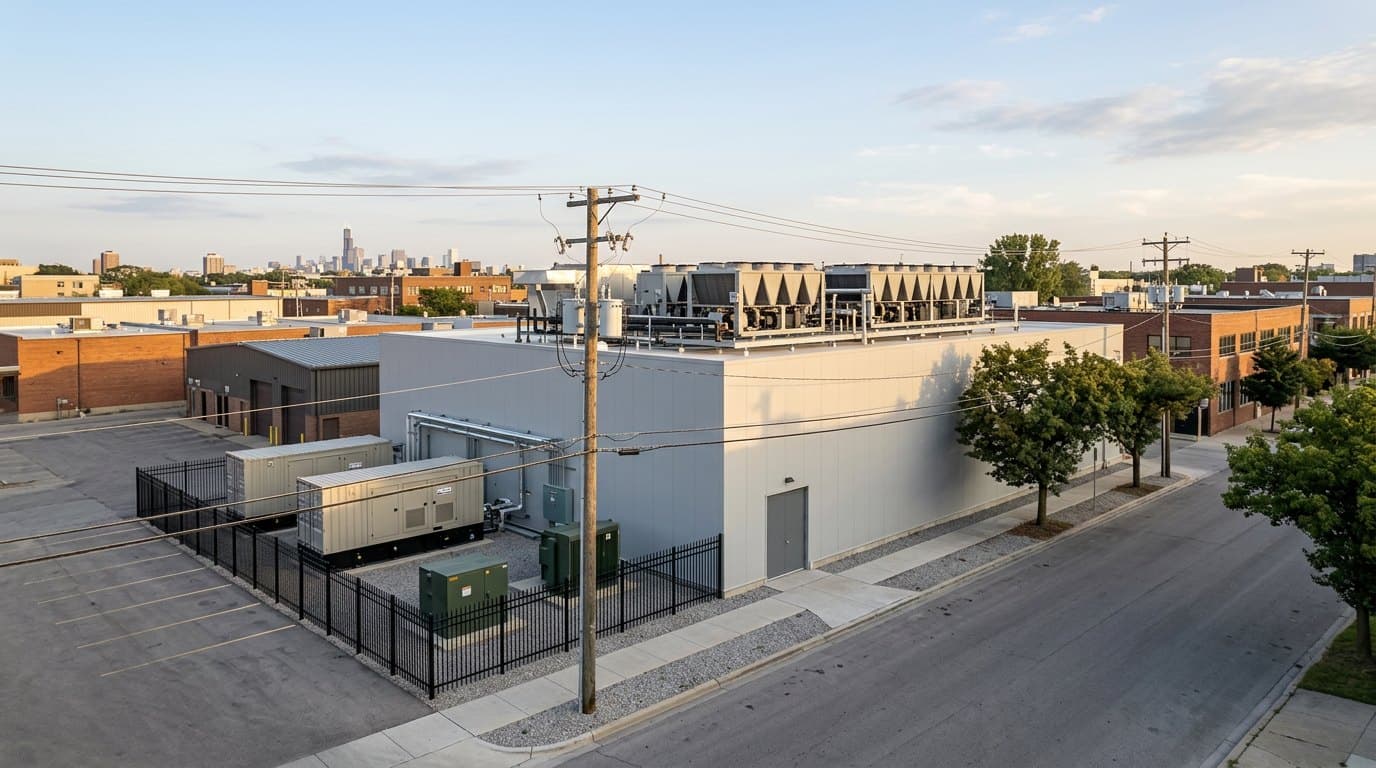
The most valuable thing about a commercial property may no longer be the building itself.
It could be the power already connected to it, its position within a constrained market, and its ability to serve growing demand for compute.
That creates a different opportunity for owners of underused or underperforming commercial assets. Instead of competing for another conventional tenant, a suitable property could be converted into edge data center capacity: infrastructure designed to put compute closer to the businesses, applications, and users that need it.
Still, identifying a promising site is only the beginning.
A viable conversion needs a customer, a development plan built around that demand, a credible funding model, and a route through construction to operation. Cerbrec brings those pieces together. We identify and qualify suitable properties, connect them with compute demand, structure the commercial opportunity, support funding and conversion, and bring completed sites into a connected data center network.
For property owners, that creates a route from an existing asset to a new source of infrastructure revenue.
Start with what makes the property valuable
Data center development has traditionally been associated with very large sites and very large power requirements. Edge infrastructure creates opportunities at a different scale.
CBRE’s H1 2026 research points to growing demand for 2 to 20 MW urban infill sites, currently driven in part by hyperscaler network infrastructure. That changes the options for owners, because many properties that would never be candidates for a hyperscale campus may still sit in exactly the locations where smaller-scale capacity is needed.
Existing power can make those sites particularly interesting. New grid connections can be difficult and slow to secure in constrained markets. A property with usable electrical capacity therefore starts from a different position from a greenfield site waiting for power.
Of course, that does not make every powered property a data center. The building, connectivity, planning environment, cooling requirements, physical configuration and economics still have to work.
That’s why Cerbrec assesses those factors together. We look at what the property has today, what would need to change, what capacity it could realistically support and where that capacity could fit into customer demand. The result is a commercial view of the asset’s potential, rather than a theoretical estimate based on power alone.
Build around demand
The economics of a conversion become much more compelling when there is a clear answer to a headline question: who is going to use the capacity?
Cerbrec works on the demand side as well as the property side. We connect qualifying sites with prospective tenants and compute requirements, bringing those conversations into the development process before significant capital is committed.
A customer might need an initial block of capacity with the option to expand. Another may have a requirement tied to a particular geography, deployment schedule or technical specification. Those details determine how much capacity should be developed, when it needs to become available and what infrastructure is actually required.
They also make the financial model more meaningful. Instead of developing a facility based largely on assumptions about future market demand, the owner can assess an opportunity against identifiable customer requirements and, as discussions progress, increasingly concrete commercial commitments.
Cerbrec’s role is to connect the real estate opportunity with the compute demand that can support it.
Work out what the conversion is actually worth
For an owner, the relevant comparison is not simply the rent the building earns today against the potential revenue of a completed data center: it’s the economics of each realistic path available for the asset.
That might mean continuing to hold it in its existing use, investing to attract another conventional tenant, selling it, redeveloping it for another purpose, or converting it into digital infrastructure.
Cerbrec models the conversion route so owners can make that comparison properly.
That includes the capital required to reach operation, the expected timing of revenue, operating costs, customer commitments, and the proposed commercial structure. It also exposes the period between investment and income, rather than presenting the economics only once the site is fully operational.
The objective is to establish whether conversion can create a stronger use for the asset before the owner commits significant capital to pursuing it. For an underleased building, that can reveal a very different commercial future from the one implied by its current rent roll.
Turn the opportunity into something that can be funded
Even a strong site with credible demand still needs capital to become operational infrastructure. Cerbrec helps qualifying projects bridge that gap.
Because the site assessment, customer requirement, and conversion model have been developed together, funding conversations can begin with a defined project: the property, the capacity it can support, the work required to deliver it, and the commercial demand behind it.
Cerbrec can introduce qualifying opportunities to funding partners or bring in a developer who provides all the funding required for the conversion. This gives property owners more flexibility in how they pursue the opportunity, including the option to unlock their asset's potential without funding the development themselves.
The exact arrangement will depend on the project. The owner’s contribution may include the property, capital or both, and the economics need to reflect the responsibilities and risk each party takes.
That financing is treated as part of the conversion model from the outset, not a problem to solve once the technical plan has already been designed.
Carry the commercial case all the way through construction
There is another gap that can undermine conversions: the one between the project that was sold commercially and the facility that eventually gets built. That’s why Cerbrec stays involved through delivery. We coordinate the specialist teams required to take qualifying properties through redevelopment and buildout, while keeping the customer requirement at the centre of the project.
That matters because construction completion alone does not necessarily create revenue. The facility needs to satisfy the technical, operational and contractual conditions that allow a customer to deploy and begin paying for capacity.
Planning, connectivity, cooling, power infrastructure, construction and commissioning therefore have to work toward the same commercial endpoint. For owners without an existing data center development team, Cerbrec provides continuity from the first assessment of the property through to operational capacity.
One building can become part of something larger
The opportunity does not necessarily end at the boundary of a single property. Edge infrastructure is inherently distributed. Customers may need capacity across several markets, while their requirements in one location can grow over time.
Cerbrec is building a network of qualifying sites rather than treating each conversion as an isolated development. That creates another dimension for property owners, particularly those with portfolios. A building can be assessed on the economics of its own conversion, but also on the role it could play within a wider network of distributed capacity.
One property might meet an immediate customer requirement. Another could provide expansion capacity. A portfolio could create coverage across several strategically useful locations. Cerbrec continues to connect and operate qualifying sites after conversion, creating a link between individual property assets and the wider infrastructure customers need.
Your existing portfolio could contain your next infrastructure asset
You don’t need to know whether your property can become a data center before speaking to Cerbrec. Establishing that is the point of the assessment.
We look at the assets you own, their location, available power, development status and current commercial position. From there, we identify which properties warrant deeper investigation, what they could support and what it would take to move them toward operation.
Some properties won’t qualify. Others may have considerably more potential in digital infrastructure than their current use suggests. Before committing more capital to an underperforming asset, find out what else it could become.